Skip to content
Synapse Horizon

Networking

400G/800G optics, InfiniBand and Ethernet switches for AI clusters in the GCC

The 400G and 800G optics, InfiniBand fabrics and high-speed Ethernet switches that link GPU servers and storage, so multi-node training and inference run at full speed inside your own datacenter.

Port speeds
400G · 800G
Fabrics
InfiniBand · Ethernet
Form factors
QSFP-DD · OSFP
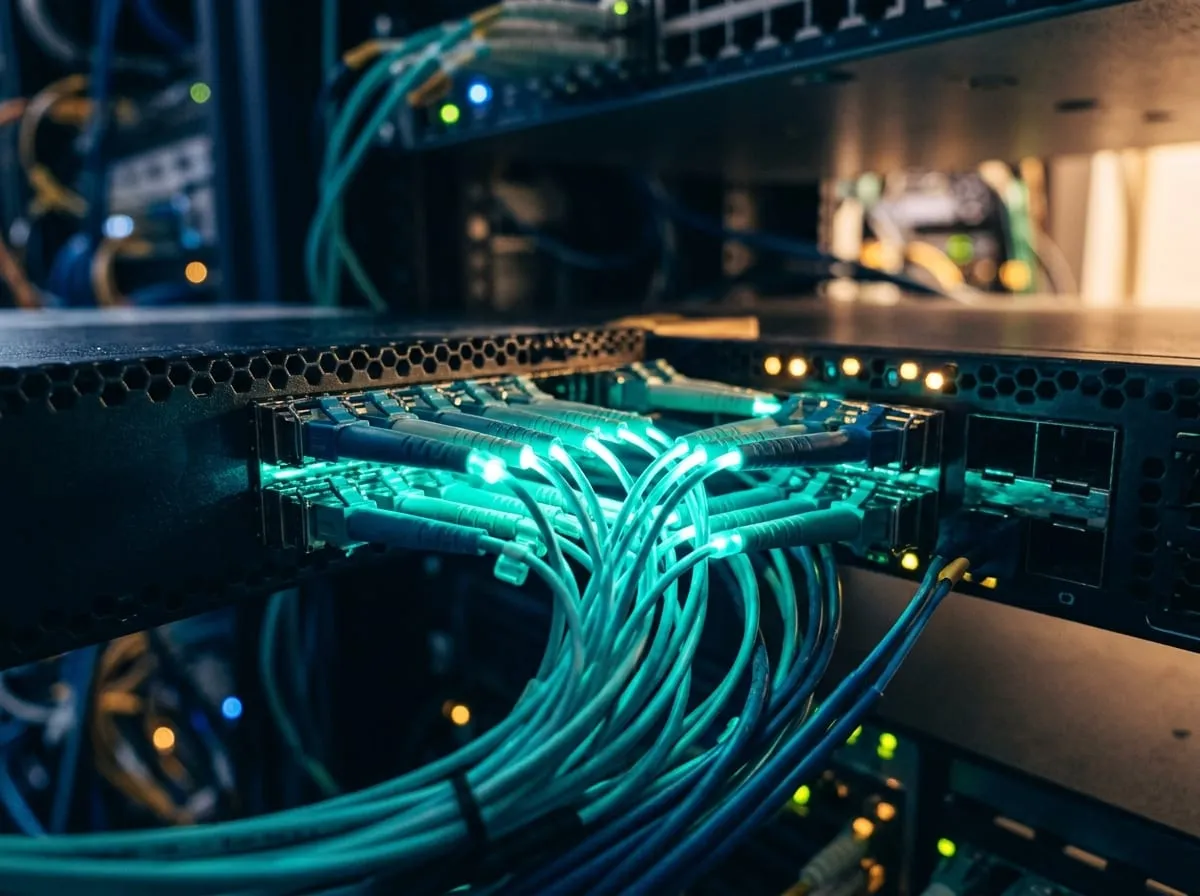
Dense fiber optic cables glowing teal in a high-speed network switch

What we supply

Networking product groups

Wholesale supply in project and container volumes. Tell us your specification and we source to it.

400G/800G optical transceivers

Pluggable optics for switch-to-server and switch-to-switch links.

  • QSFP-DD and OSFP form factors for 400G and 800G ports
  • Multimode short-reach (SR) optics for in-row links
  • Single-mode DR and FR optics for runs from 500 m to 2 km
  • Digital diagnostics monitoring on every module
  • Available coded for the target switch platform
Quote this: 400G/800G optical transceivers

InfiniBand cables and switches

Low-latency fabrics for multi-node GPU training.

  • 400 Gb/s-per-port InfiniBand switches for fat-tree fabrics
  • Direct-attach copper cables for in-rack links
  • Active optical cables and transceivers for longer runs
  • In-network collective offload that speeds up distributed training
  • Subnet management and fabric monitoring tools for day-to-day operations
Quote this: InfiniBand cables and switches

High-speed Ethernet switches

Ethernet fabrics for AI, storage and management networks.

  • 400GbE and 800GbE spine and leaf switches
  • RoCEv2 support with PFC and ECN for lossless GPU traffic
  • 25/100GbE switches for storage, management and campus uplinks
  • Telemetry and automation APIs for fabric monitoring
  • Separate out-of-band management switches for BMC and console access
Quote this: High-speed Ethernet switches

Applications

Where it is used

01

GPU training fabrics

Distributed training exchanges gradients between GPUs on every step, so network bandwidth and latency directly limit training speed. Non-blocking InfiniBand or RoCE Ethernet fabrics, often laid out rail by rail, give each GPU its own high-speed link. Our partners design the topology to your node count and growth plan.

02

Inference clusters

Serving large models across several servers needs fast links between them and to the application tier. Well-designed leaf-spine Ethernet keeps latency predictable as users grow. Separating inference traffic from storage and management networks protects response times when you run batch jobs.

03

Storage networks

Training reads large datasets and writes frequent checkpoints. A dedicated high-bandwidth storage network, or a separated class on a converged fabric, keeps GPUs supplied with data. NVMe storage nodes with 100G or 400G links avoid I/O bottlenecks that leave expensive accelerators idle.

04

Campus and datacenter interconnect

Single-mode optics connect server rooms, buildings and disaster-recovery sites over private fibre, at distances from a few hundred metres to several kilometres. This lets organisations spread AI workloads across their own facilities while keeping every hop inside their network, which supports data-sovereignty and resilience requirements.

Why Synapse Horizon

Supplied by us, delivered with our partners

Tier-1 sourcing

Switches, optics and cables sourced from Tier-1 networking manufacturers and authorised channels.

Documentation and compliance support

Datasheets and laser-safety and EMC certificates available on request, with export questions raised early for procurement review.

Logistics coordinated from Dubai

Shipments can be consolidated in Dubai and delivered by road or sea across the UAE, Saudi Arabia, Oman, Qatar, Kuwait and Bahrain, and onward to wider MENA.

Partner integration and deployment

Our integration and AI-deployment partners handle site survey, racking, cabling, burn-in and software stack set-up, so hardware arrives as a working system.

FAQ

Networking questions

InfiniBand or Ethernet for an AI cluster?
InfiniBand offers very low latency, built-in congestion control and in-network collectives, and it is widely used for large training clusters. Ethernet with RoCEv2 has closed much of the gap and fits teams with existing Ethernet skills. For inference and smaller clusters, Ethernet is often enough. We help you compare both options before you buy.
Which optics do I need for each link?
Reach decides it. Direct-attach copper suits links within a rack, and short-reach multimode optics or active optical cables suit links within a row. Single-mode DR and FR optics cover longer runs between rows or rooms. Also match the form factor, such as QSFP-DD or OSFP, and the switch platform coding.
What is rail-optimised networking?
In a rail-optimised design, GPU number one in every server connects to the same leaf switch, GPU number two to another, and so on. Most collective traffic then stays within one switch hop, which lowers latency and makes better use of the fabric. It suits multi-node training clusters with eight GPUs per node.
How do you ensure transceiver compatibility?
Switches can reject optics that are not coded for their platform. We can confirm the switch model and software version, then supply modules coded for that platform, with diagnostics data available. Our partners can run link tests during installation, so problems are fixed before the cluster goes live.
Can we reuse our existing fibre plant?
Sometimes. Older multimode fibre may not support 400G and 800G short-reach optics over the distances you need, and parallel optics require MPO trunks with the right fibre count. Single-mode fibre is more future-proof. Our partners can test and document existing links, then recommend reuse, new trunks or a different optic type.

Request a quote

Request a quote for Networking

Share quantities, specifications, delivery location and timeline. No obligation, and we reply within one business day.