Insights / Energy
EnergySingle axis tracker desert guide: yield, dust, wind and O&M in the Gulf
· 9 min read
On this page
This single axis tracker desert guide explains why almost every large new solar plant now moves with the sun. It also covers what the desert adds to the decision: dust, sand, high winds and heat.
A single-axis tracker turns rows of modules from east to west through the day. The gain is real, but so are the extra moving parts. This guide sets out the numbers, then tests what you know with a short quiz.
Why do utility plants now choose single-axis trackers?
Trackers have become the default for ground-mounted utility solar. Lawrence Berkeley National Laboratory reports that 99% of new utility-scale PV capacity in the United States in 2024 chose single-axis tracking. Fixed tilt is now used only in edge cases, such as difficult terrain or high wind loading.
The main reason is energy. A tracker keeps modules closer to facing the sun in the morning and afternoon, when fixed modules see the sun at a steep angle. Berkeley Lab finds tracking adds more than five percentage points to capacity factor in the sunniest US regions.
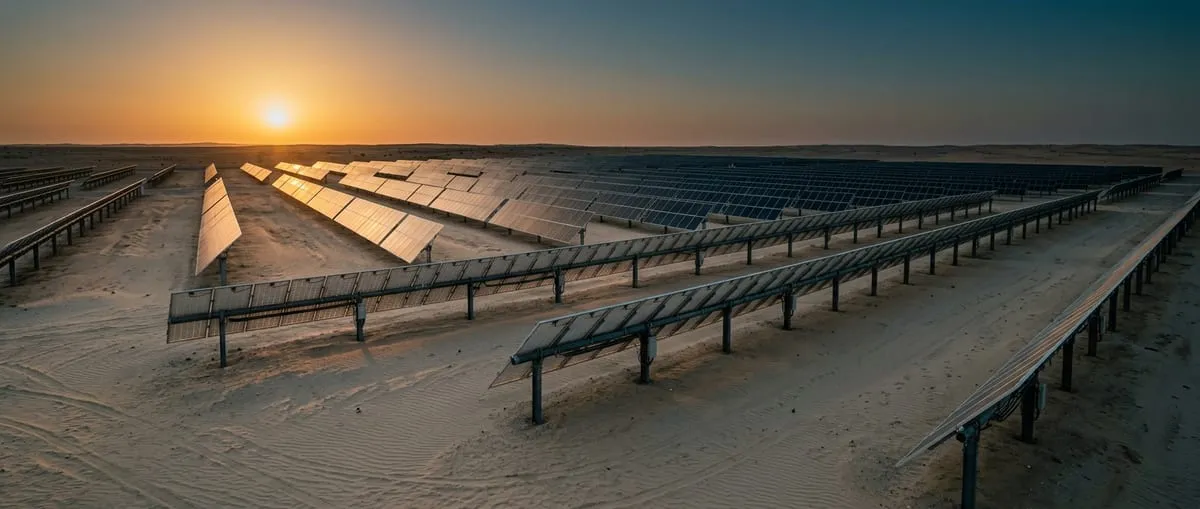
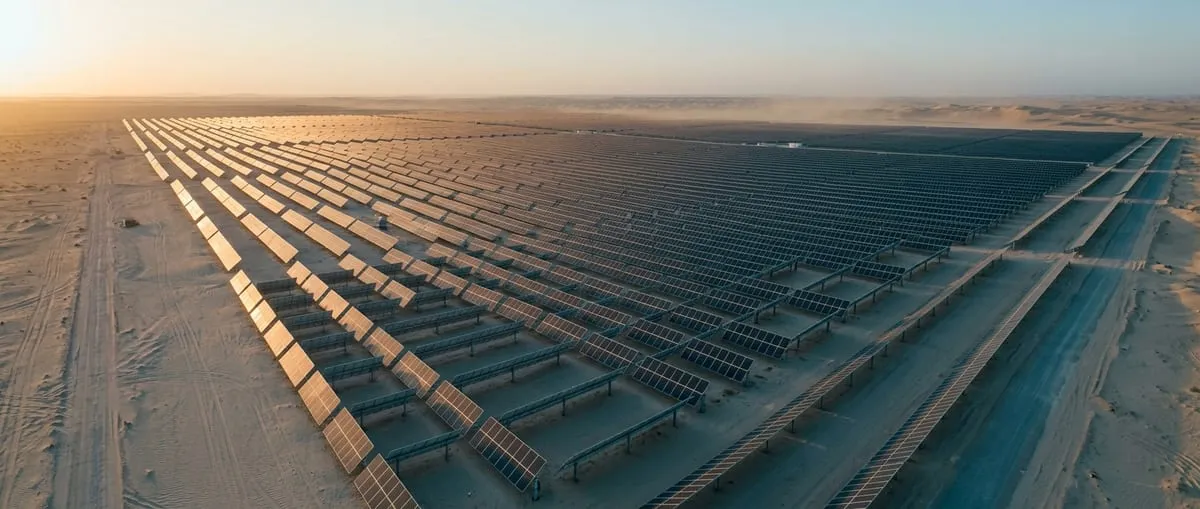
The Gulf follows the same pattern. Abu Dhabi’s Al Dhafra plant, at 2.1 GWp (1.64 GWac), mounts more than four million bifacial modules on single-axis trackers across over 20 km² of desert. It began commercial operation in June 2023.
How does a single-axis tracker work?
Most utility trackers run their rotation axis north to south. Each row turns about that axis to follow the sun from east to west. A controller calculates the sun’s position and drives a motor, which turns a torque tube carrying the modules.
Two control features matter most in the desert:
- Backtracking: in the early morning and late afternoon, rows flatten slightly so they do not shade each other.
- Stow: the controller moves rows to a safe angle in high wind, and can also park them at a chosen angle overnight.
How well do you know desert tracker risks?
Test your knowledge with six questions on soiling, wind stow, sand, albedo and maintenance. Each answer links back to published research, and the explanations appear when you submit.
Interactive estimate
Quiz: single-axis trackers in the desert
Assumptions
- Soiling, stow and summer-dust questions: Aïssa et al. (2023), "A Comprehensive Review of a Decade of Field PV Soiling Assessment in QEERI’s Outdoor Test Facility in Qatar", Energies 16, 5224.
- Wind question: Rohr, Bourke and Banks (2015), "Torsional Instability of Single-Axis Solar Tracking Systems", 14th International Conference on Wind Engineering; NREL (2020) full-scale tracker wind-load campaign.
- Albedo question: IEA PVPS Task 13, "Bifacial Photovoltaic Modules and Systems" (T13-14:2021).
- O&M question: NREL, Sandia and SunSpec, "Best Practices for Operation and Maintenance of Photovoltaic and Energy Storage Systems", 3rd edition.
- Unanswered questions count as wrong.
Indicative estimate only. Contact us for an engineered proposal.
The rest of this guide explains each topic in more detail, starting with yield.
How much more energy does a single axis tracker desert plant produce?
We modelled six MENA cities in PVGIS, the European Commission’s free solar yield tool. The fixed case uses the best tilt and orientation for each city. The tracker case uses a horizontal north-south axis. Both use the same 14% system losses.
| City | Fixed, best tilt (kWh/kWp/yr) | Single-axis tracker gain |
|---|---|---|
| Dubai | 1,722 | 18.2% |
| Abu Dhabi | 1,753 | 20.1% |
| Riyadh | 1,777 | 19.1% |
| Muscat | 1,755 | 17.6% |
| Doha | 1,712 | 18.2% |
| Cairo | 1,819 | 23.7% |
In Dubai, the tracker lifts yield from about 1,722 to about 2,036 kWh per kWp a year. The gain is largest in Cairo, the most northerly city in the table.
These are modelled figures before extra soiling, and before any bifacial gain. Our TOPCon vs HJT guide includes a calculator that combines tracker and bifacial gains for each city.
Does tracking change the inverter design?
Tracker plants now carry a larger DC array per inverter than they used to. NREL’s cost benchmarks raised the inverter loading ratio for tracker plants from 1.10 in 2010 to 1.34, where it has stayed since about 2019. Berkeley Lab found little difference in this ratio between fixed and tracking US plants built in 2024. For the inverter choice itself, see our guide to string vs central inverters.
How does dust and sand affect trackers?
Dust is the biggest running cost for desert solar. At the Qatar Environment and Energy Research Institute (QEERI) test site near Doha, soiling cut output by 0.3–0.5% per day, depending on the season. Losses were highest in summer, when dust events are more common and rain is practically absent. From July to October, the modules’ cleanliness fell by about 20% a month.
Several local effects make Gulf dust hard to handle:
- Dew: modules cool below air temperature at night. Pre-dawn dew can bind dust to the glass, which makes it harder to remove.
- Wind: QEERI found winds above about 4 m/s greatly help lift particles off the surface.
- Tilt: less dust settles on steep surfaces. One study cited by QEERI found nine times less soiling on vertical modules than on modules tilted at 30°.
Can tracker stow reduce soiling?
Yes, and fixed systems cannot do this. QEERI’s research suggests stowing one-axis trackers at their steepest angle overnight, facing the wind. Dust then has less chance to settle, and wind helps clear what does.
Trackers still need cleaning. Plan the cleaning cycle around measured soiling, not the calendar. A soiling sensor or a pair of clean and soiled reference cells shows when cleaning pays for itself.
Sand also affects the moving parts. Ask suppliers how drives, bearings and slew gears are sealed against fine dust. Ask too what lubrication they need in desert conditions.
How should trackers handle desert wind?
Wind is the main structural risk for trackers. A long row of modules on a single torque tube can twist more easily than it can bend. NREL’s field campaign notes that wind-related failures are widespread and that stow guidance has been unclear.
Many trackers stow flat in high winds, to reduce static loads. Wind engineers found this can cause trouble. Their tests showed that near-flat trackers can suffer torsional galloping. In this twisting vibration, vortices shed from the leading edge and add energy with each cycle.
The researchers found the effect hard to damp out. They recommend that isolated trackers and trackers on the edge of arrays should not sit flat in high winds. NREL’s field data also show that loads are sensitive to stow angle.
What should you ask a tracker supplier about wind?
Ask for evidence, not only a wind speed rating:
- Wind-tunnel testing: static and dynamic tests on the actual tracker design, including edge rows.
- Stow strategy: the stow angle, trigger wind speed and how fast rows reach stow.
- Wind sensors: how many anemometers, where they sit and what happens if one fails.
- Backup power: whether rows can reach stow during a grid outage.
- Design qualification: test results to IEC 62817, the design qualification standard for solar trackers.
Local design codes and your site’s wind data set the loads. Your structural engineer should check them against the supplier’s test results.
Do bifacial modules and desert albedo change the case?
Bifacial modules collect light on both sides. On a tracker, the rear side faces the ground, which reflects light upwards. How much it reflects is called albedo.
IEA PVPS reports that bifacial modules on single-axis trackers give the lowest cost of electricity for 93% of the Earth’s land area. Over typical ground, with albedo of 0.2 to 0.3, bifacial gains on trackers are generally below 10%. A desert tracker plant in Chile measured gains of 10.4–12.4%.
Soiling hits the rear side much less. Studies reviewed by QEERI report a total soiling rate of 0.236% per day for bifacial modules, of which just 0.0394% per day was on the rear side. Monofacial modules lost 0.301% per day.
To compare bifacial cell technologies, see our TOPCon vs HJT guide. Our solar PV range covers bifacial modules and single-axis trackers.
What O&M does a single axis tracker plant need?
Trackers add mechanical work that fixed plants do not have. NREL’s O&M best-practice guide lists annual inspections for trackers, including:
- controllers, motors and electrical connections
- driveshaft torque and slew-gear torque and wear
- inclinometers, limit switches and anemometers
- gears, gearboxes, universal joints and bearings
It also lists lubrication of gearboxes, screw jacks, slew gears and bearings to the maker’s schedule. Controller backup batteries need replacing during the tracker’s life, even if they are only used for backup.
Monitoring matters as much as spanners. Track each row’s angle against its target, so a stuck row shows up as an alarm rather than a slow drop in yield. NREL also suggests adjusting availability calculations for tracking issues.
Keep spares for the parts that fail most on your design, such as controllers and motors. In the Gulf, that keeps a failed row from sitting flat and idle through the summer peak.
How do you decide between tracker and fixed tilt?
For most large Gulf ground-mount sites, trackers are the starting point. Berkeley Lab found the upfront cost premium for trackers has faded over time, while the 18–20% yield gain remains. Fixed tilt still suits some cases:
- small or awkwardly shaped plots
- steep or uneven ground
- sites with extreme wind exposure
- rooftop and carport systems
Run both designs through the same yield model and the same cleaning plan. Then compare lifetime cost per MWh, including O&M and stow losses.
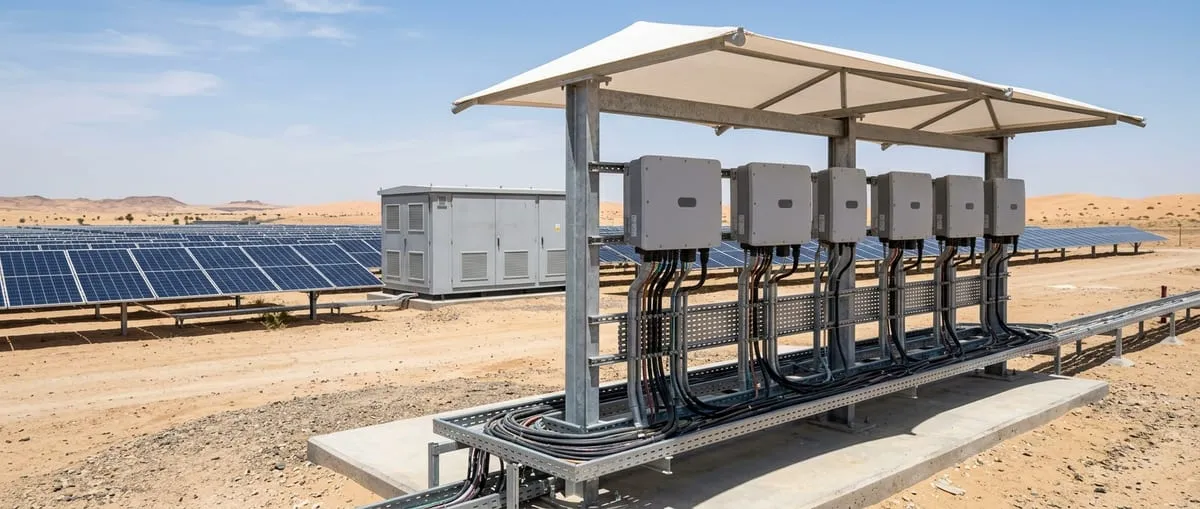
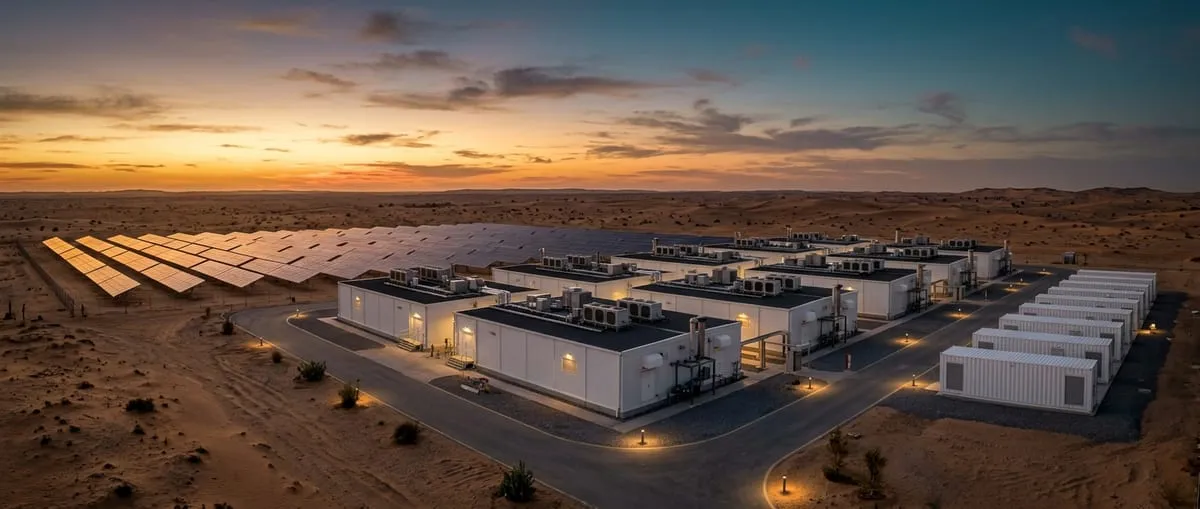
If the plant will feed a large, constant load, storage matters too. See our guides to sizing C&I battery storage in the GCC and solar and storage for AI data centres. Our balance of system range covers the cabling and combiner boxes that link tracker rows to inverters.
Key takeaways
- PVGIS modelling puts single-axis tracker gains at about 18–20% for Dubai, Abu Dhabi and Riyadh, and higher in Cairo.
- 99% of new US utility-scale capacity chose single-axis tracking in 2024. Fixed tilt now mainly suits difficult terrain or high wind.
- Qatar research measured soiling of 0.3–0.5% per day. Steep night stow facing the wind can reduce build-up.
- Near-flat trackers can gallop in high wind. Base stow strategy on wind-tunnel tests and check IEC 62817 results.
- Bifacial modules on trackers are the lowest-cost choice for most land, and the rear side soils far less than the front.
Frequently asked questions
How much more energy does a single-axis tracker produce in the UAE?
Do trackers get dirtier than fixed panels in the desert?
What is tracker wind stow?
Are bifacial modules worth it on trackers?
What maintenance does a single-axis tracker need?
Sources
- European Commission Joint Research Centre –PVGIS 5.3 photovoltaic performance tool (PVcalc, PVGIS-SARAH3)
- Lawrence Berkeley National Laboratory –U.S. Utility-Scale Solar, 2025 Data Update
- Energies (Aïssa et al., 2023), Qatar Environment and Energy Research Institute –A Comprehensive Review of a Decade of Field PV Soiling Assessment in QEERI's Outdoor Test Facility in Qatar
- 14th International Conference on Wind Engineering (Rohr, Bourke and Banks, 2015) –Torsional Instability of Single-Axis Solar Tracking Systems
- National Renewable Energy Laboratory (Dana and Young, 2020) –Aeroelastic Modeling and Full-Scale Loads Measurements for Investigation of Single-Axis PV Tracker Wind-Driven Dynamic Instabilities
- IEA PVPS –Bifacial Photovoltaic Modules and Systems (Report IEA-PVPS T13-14:2021)
- NREL, Sandia National Laboratories and SunSpec Alliance –Best Practices for Operation and Maintenance of Photovoltaic and Energy Storage Systems, 3rd Edition
- International Electrotechnical Commission –IEC 62817 Photovoltaic systems: Design qualification of solar trackers
- Climate Bonds Initiative –Al Dhafrah Solar PV2 achieves Climate Bonds Certification