Insights / Energy
EnergyString vs central inverter vs hybrid: which one fits your GCC project?
· 9 min read
On this page
The string vs central inverter decision shapes a solar plant for 25 years. It sets how much energy you lose to shading, how long a fault keeps power offline and how your team handles spares. Hybrid inverters add a third option when a battery is part of the plan.
This guide compares all three for GCC and MENA projects. It covers size bands, shading, heat, reliability data and Dubai’s approval rules. A 5-question tool gives you a starting recommendation.
What does each inverter type do?
Every grid-connected PV system needs an inverter to turn the DC power from modules into AC power for the site or grid. The three types differ in how much of the array each unit handles.
- String inverters connect a handful of module strings. Commercial units are three-phase, and a plant uses many of them spread across the array.
- Central inverters collect DC from many strings through combiner boxes. One unit, usually in a skid or station with a transformer, serves a whole block of the plant.
- Hybrid inverters are string-type inverters with a battery port. They manage solar, battery and grid in one unit, and many can keep critical loads running during an outage.
A key feature is the maximum power point tracker (MPPT). Each MPPT finds the best operating point for the strings connected to it. More MPPTs mean more parts of the array can work at their own best point.
How does the industry use them today?
NREL’s cost benchmarks show the split clearly. Its commercial systems of 100 kW to 2 MW use three-phase string inverters. Its 3 MWdc community solar benchmark also uses string inverters. Its utility-scale plants of 5 to 100 MW use central inverters.
String inverters are gaining ground even at utility scale. PV Tech Research reports that string inverters made up about 60% of global inverter manufacturing capacity in 2021 and over 70% by 2024.
Which inverter fits your project?
Answer five questions about size, site, shading, storage and off-grid needs. The tool applies the rules in this guide and explains its choice.
Interactive estimate
Which inverter type fits your project?
Question 1 of 5
How large is the system, in kW AC?
Use AC output. As a rough guide, DC module power is often 1.2–1.35 times the AC rating.
Assumptions
- Hybrid is suggested when you need storage or off-grid operation at up to 1,000 kW AC. Commercial three-phase hybrid units currently reach about 125 kW each and parallel up to about six units (manufacturer datasheets). NREL's commercial PV-plus-storage benchmark models a 1 MWdc system (about 770 kW AC when DC-coupled) on one bidirectional inverter.
- Central is suggested only for utility sites of 5,000 kW AC or more without partial shading. NREL's cost benchmarks define utility-scale PV as 5–100 MW and model it with central inverters, while commercial and community systems up to a few MW use three-phase string inverters.
- Everything else defaults to string inverters, which give more MPPT inputs, smaller failure blocks and simpler spares.
- This is a first screen. Grid code, utility approval lists (for example DEWA eligibility under the DRRG standards), land shape, cabling and site temperature can change the answer.
Indicative estimate only. Contact us for an engineered proposal.
The tool gives a first screen, not a design. Land shape, cable runs, grid code and your utility’s approval list can all change the answer. The sections below explain the reasoning behind each rule.
When does a string inverter make sense?
String inverters are the default for most commercial and industrial (C&I) solar in the Gulf. They fit rooftops, carports and ground-mounts from a few kilowatts to several megawatts.
Their first strength is handling shade and mixed orientations. Parapets, rooftop HVAC units, lift rooms and nearby buildings all cast shadows. A roof may also have module rows facing different directions. With several MPPTs per unit, a shaded string does not drag down the others.
NREL’s shading tests show how much finer tracking can matter. Module-level electronics raised output by 3.7% under light shading, 7.8% under moderate shading and 12.3% under heavy shading, compared with a string inverter. The same logic applies one level up: a string inverter with many MPPTs loses less than one central inverter tracking a whole block.
Their second strength is fault tolerance. If one unit fails, only its strings stop. The rest of the plant keeps running while a technician swaps the unit.
What about spares and service?
String inverters are small enough for two people to handle. A site can keep one or two spare units in stock and replace a failed one in hours. That suits Gulf sites where specialist service teams may be far away.
For a multi-site portfolio, using one string inverter model across all sites simplifies spares further. It also makes training and monitoring easier.
When does a central inverter make sense?
Central inverters make sense for large, flat, unshaded utility plants. We use 5 MW AC as the point where they are worth comparing, in line with NREL’s utility-scale range of 5 to 100 MW.
On a uniform desert site, every string sees the same sun, so fine-grained MPPT adds little. Central inverters then offer fewer units, fewer AC connections and a single station per block. The inverter, transformer and switchgear often arrive as one skid, which suits fast construction.
NREL’s 2023 utility benchmark models a 100 MWdc single-axis tracker plant with central inverters and an inverter loading ratio of 1.34. This means the DC array is 34% larger than the AC inverter rating, a common way to use the inverter well through the day.
What is the downside?
The main downside is the size of each failure. PV Tech Research notes that when a central inverter fails, a megawatt-scale block of the plant goes offline at once. Repair may need specialist staff and parts.
That risk matters because inverters are the most frequent cause of service calls. A review of operator data found inverters account for 43% to 70% of PV plant service requests. The inverter has been reported as the largest single cause of lost energy, at up to 36% of energy losses.
If your site has uneven terrain, partial shade from structures, or a mix of tracker and fixed blocks, string inverters usually win even at utility scale.
When does a hybrid inverter make sense?
A hybrid inverter makes sense when a battery is part of the plan and the system is no larger than about 1 MW AC. One unit manages the solar array, the battery and the grid connection. Many models also switch critical loads to backup during a grid outage.
Hybrid designs are a form of DC coupling. NREL’s benchmark lists the main benefits of DC-coupled storage:
- One inverter instead of two, which saves on the inverter, wiring and housing.
- Higher round-trip efficiency, because solar energy avoids an extra DC-to-AC-to-DC step on its way into the battery. NREL notes the gap is shrinking as power electronics improve.
- Captured clipping, because solar output above the inverter limit can go straight into the battery.
- One grid connection point, which simplifies approvals.
NREL’s commercial PV-plus-storage benchmark pairs a 1 MWdc PV system (about 770 kW AC when DC-coupled) with a 600 kW battery, in both DC-coupled and AC-coupled versions. Above about 1 MW, most designs use string or central PV inverters plus a separate battery inverter, called a power conversion system (PCS). This AC-coupled layout scales better and lets you size solar and storage separately.
To size the battery itself, see our guide to C&I battery storage sizing in the GCC. For chemistry, see why LFP dominates energy storage.
How does Gulf heat affect inverter choice?
Heat affects every inverter type. Power electronics lose efficiency and output as they heat up, and most units reduce their output above their rated ambient temperature. Check the derating curve on each datasheet against your site’s summer peak.
Cooling fans are a common wear part. One study measured a fan operating at up to 56.5 °C in a PV inverter. The fan was rated for 12.5 years at 60 °C, so the authors recommended replacing it at year 10. In the Gulf, plan fan and filter replacement into your maintenance budget.
Practical steps help with any inverter type:
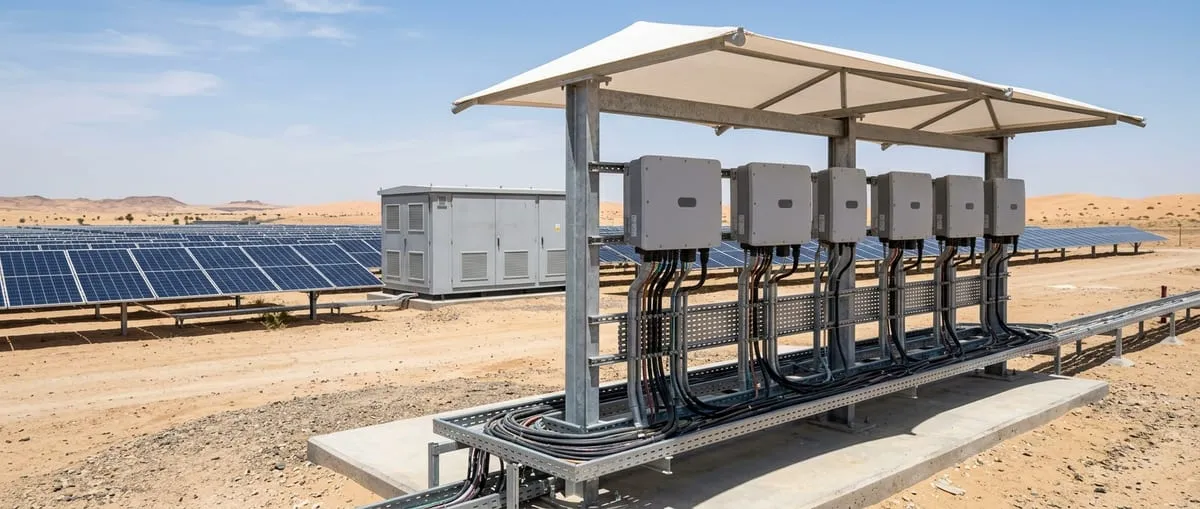
- Shade the inverters. Mount string inverters under a canopy or on the north side of a structure.
- Leave clearance. Follow the datasheet’s spacing so hot air can escape.
- Keep filters clean. Dust blocks airflow and raises internal temperatures.
- Monitor temperatures. Alarms for internal temperature catch cooling problems before they cause faults.
Dust and sand also matter. Ask for the enclosure’s ingress protection (IP) rating, and check it suits outdoor desert installation.
What certifications and approvals do GCC projects need?
Grid rules vary across the region, so confirm your utility’s requirements early. Dubai’s rules are a good example of what to expect.
DEWA’s equipment eligibility page lists the minimum requirements for PV inverters connected under Shams Dubai:
- Safety: IEC 62109-1 and IEC 62109-2, or UL 1741. IEC 62109-2 covers the particular safety needs of DC-to-AC inverters for PV.
- Power quality: IEC 61000-3-2 or IEC 61000-3-12, plus electromagnetic compatibility standards from the IEC 61000-6 series.
- Grid compliance: the compliance tests for inverters in DEWA’s DRRG standards, for low- or medium-voltage connections.
- Harmonic data: a harmonic spectrum for each inverter model, submitted with the application.
Approved equipment appears on DEWA’s eligible equipment list, now kept in its online DRRG equipment portal. Buy from that list for any Dubai project. For other GCC markets, ask your supplier for the utility’s approval letter or equivalent certificate.
How do you compare quotes for string vs central inverter designs?
Compare whole designs, not just the inverter line item. A string design moves some cost into AC cabling and many small units. A central design moves it into DC combiner boxes, cabling and a station.
Ask each bidder for the same set of figures:
- Energy yield: annual MWh from the same simulation tool and weather data, with shading and clipping losses shown.
- Inverter loading ratio: the DC-to-AC ratio. For NREL’s tracker benchmarks it rose from 1.10 in 2010 to 1.34, where it has stayed since about 2019.
- Availability: the uptime the design and service plan will guarantee.
- Service plan: spares held on site, response times and who does repairs.
- Warranty: length, what it covers and whether it can be extended.
Then compare the lifetime cost per MWh, not the upfront cost alone. Our solar PV range covers string, central and hybrid inverters from Tier-1 manufacturers. Our balance of system range covers the combiner boxes, cabling and switchgear around them.
If you are also choosing modules and mounting, see TOPCon vs HJT modules in the UAE and single-axis trackers in the desert.
Key takeaways
- String inverters are the default for rooftops, carports and most C&I ground-mounts. They handle shade well and limit the impact of any single fault.
- Central inverters suit flat, unshaded utility plants from about 5 MW AC, in line with NREL’s utility-scale benchmarks.
- Hybrid inverters suit systems up to about 1 MW AC that need a battery, backup or off-grid operation. Larger systems add a separate battery inverter.
- Inverters cause 43–70% of PV service requests, so spares and service matter as much as the datasheet.
- In Dubai, buy from DEWA’s eligible equipment list and budget for fan and filter replacement in the heat.
Frequently asked questions
What is the main difference between a string and a central inverter?
At what size do central inverters make sense?
When should I choose a hybrid inverter?
Are string inverters more reliable than central inverters?
What certifications do inverters need in Dubai?
Sources
- National Renewable Energy Laboratory (NREL), via OSTI –U.S. Solar Photovoltaic System and Energy Storage Cost Benchmark: Q1 2021
- National Renewable Energy Laboratory (NREL/NLR) –U.S. Solar Photovoltaic System and Energy Storage Cost Benchmarks, With Minimum Sustainable Price Analysis: Q1 2023
- National Renewable Energy Laboratory (NREL/NLR) –Documenting 15 Years of Reductions in U.S. Solar Photovoltaic System Costs
- Renewable and Sustainable Energy Reviews (Hacke et al., 2018) –A status review of photovoltaic power conversion equipment reliability, safety, and quality assurance protocols
- National Renewable Energy Laboratory (Deline et al., 2012) –Photovoltaic Shading Testbed for Module-Level Power Electronics
- Dubai Electricity and Water Authority (DEWA) –Solar PV Equipment Eligibility
- International Electrotechnical Commission –IEC 62109-2:2011 Safety of power converters for use in photovoltaic power systems, Part 2
- PV Tech Research –The global shift from central to string inverters: market dynamics, regional strategies and policy implications